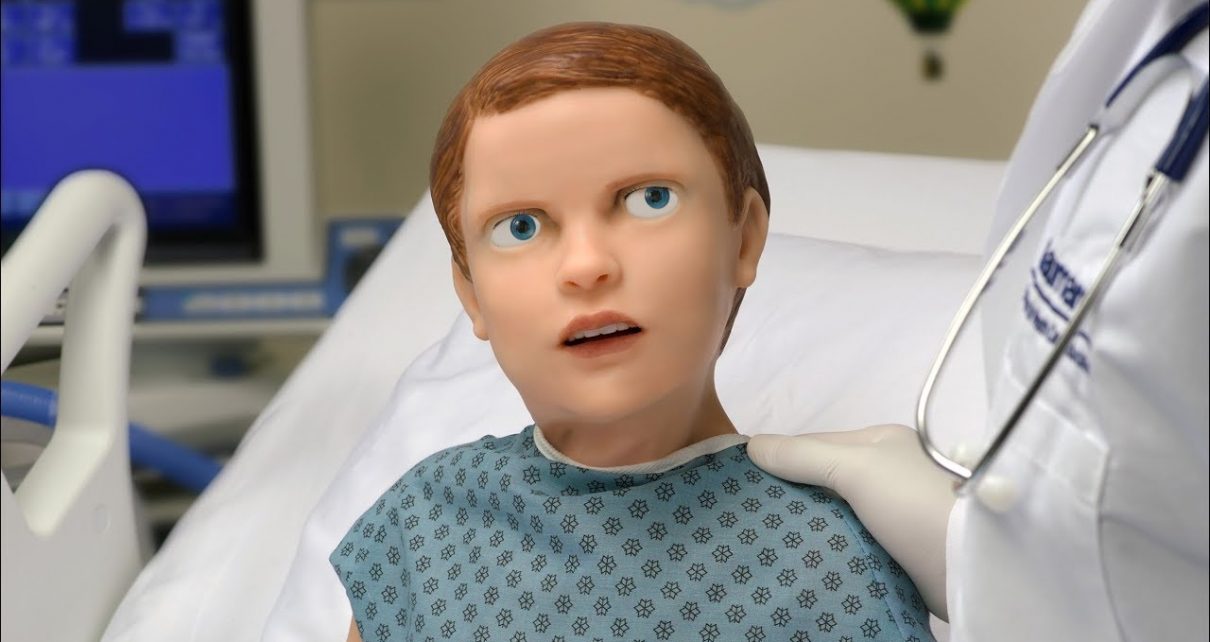
Let’s pretend you’re a medical student learning how to perform a certain operation. It’s late one night and you’re in the classroom all alone, trying to perfect a particularly challenging procedure on a mannequin of a young kid. You move your scalpel-wielding hand into place and … wait, that mannequin’s eyes didn’t move, did they? Of course not, you reassure yourself. Suddenly, the mannequin lurches to life, thrashing around on the gurney, its breathing rapid and scared, its eyes wide and darting.
Is this the start of some new horror movie franchise set in a haunted hospital? Nope. It’s Pediatric Hal, a creepily lifelike new robot created by the folks at medical training company Gaumard Scientific. Made to look like a 5-year-old male patient, Hal is able to answer questions, track fingers with his eyes, cry for his robot parents, urinate when scared, say “Ow!” when pricked with a needle, and mimic the symptoms of assorted medical ailments — including arrhythmia and cardiac arrest. No wonder its creators refer to it as “The World’s Most Advanced Pediatric Patient Simulator.”
The idea of the robot is to allow medical students to come to grips with everything from inserting tracheal tubes into a patient’s throat to using a defibrillator by giving them a mannequin to learn on before they move on to the real thing. However, while practicing operations is one thing, being able to perform them under pressure is quite another. That’s where the idea of Hal comes into its own, since it exhibits the behavior that surgeons may have to face when dealing with real patients later in their careers.